14x36x1 Attic Air Handler Filter Replacement | Safety Tips
TL;DR
Check the hallway return grille first. On many systems, the filter lives there, not in the attic, and you never need to climb. If it really is at the air handler, changing a 14x36x1 is a ten-minute job wrapped in three real hazards: attic heat, a fall through the ceiling, and a filter that's too long to handle one-handed on a ladder. Go up in the early morning, kill power at the disconnect, keep both hands free on the ladder, and never fold the filter to make it fit. If the attic is over roughly 120°F, come back tomorrow.
The Short Answer
Replace a 14x36x1 attic air filter in the early morning, before the attic heats up. Shut the system off at the thermostat and at the air handler disconnect. Climb with both hands free and have the filter handed up or hauled up separately, because a 35.5-inch panel is unwieldy on a ladder. Step only on joists or decking, slide the new filter in with the airflow arrow pointing toward the blower, and reseal the access door completely.
Key Takeaways
● Many homes with attic air handlers hold the filter behind the hallway ceiling return grille. Check there before planning an attic trip.
● Schedule changes into November through March where you can. In most of the country, an attic sits near outdoor temperature in those months.
● Attic temperatures commonly run 120°F to 150°F in summer and can exceed 160°F in poorly ventilated attics. That is hot enough to bring on heat exhaustion within minutes.
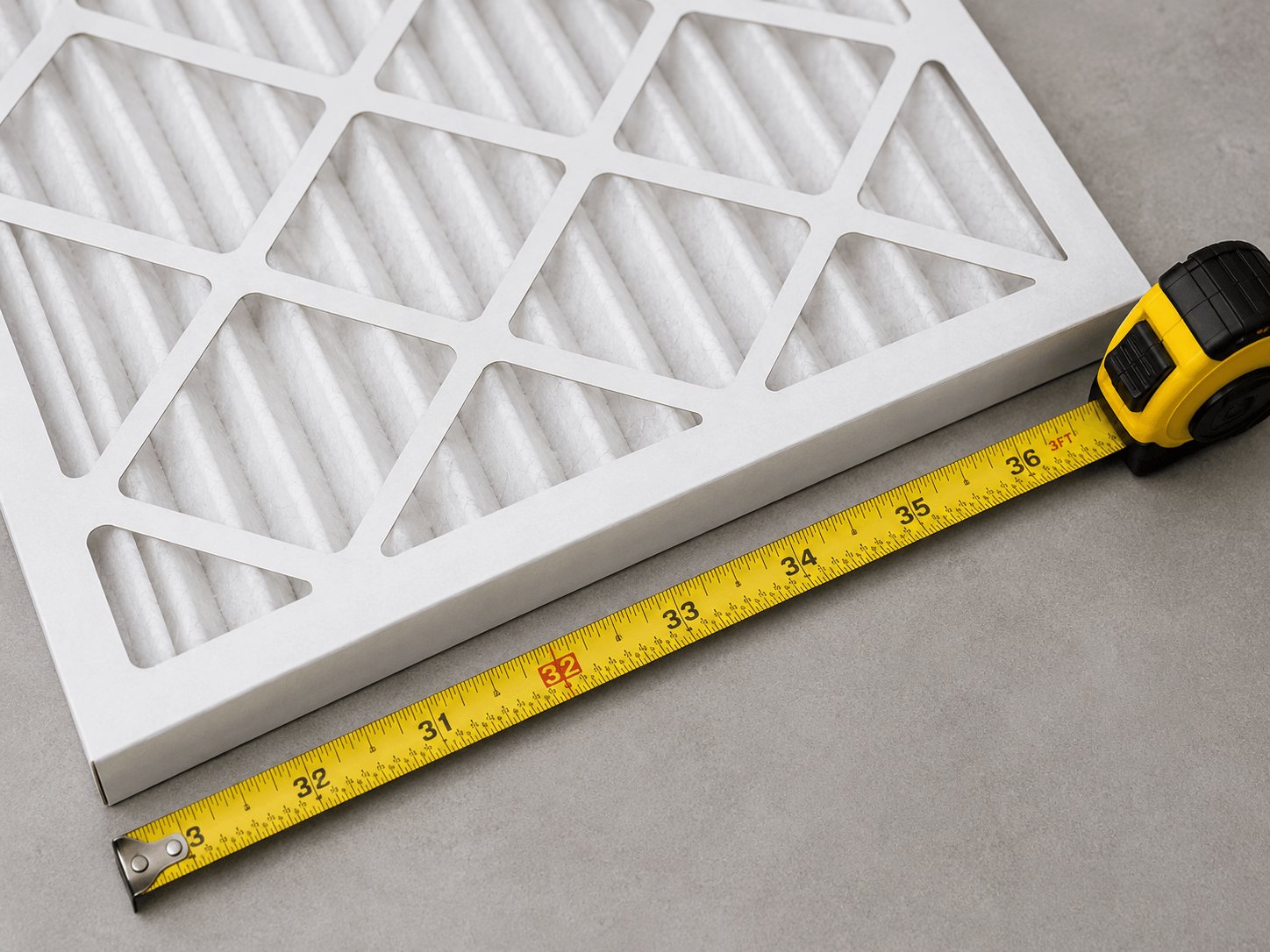
● A 14x36x1 is a nominal size. The actual panel measures 13.5 x 35.5 x 1 inches, which is why it slides into a 14x36 track with clearance rather than wedging.
● Never carry a long filter up a pull-down ladder in one hand. NIOSH names carrying objects while going up or down a ladder as one of the five major causes of ladder fall incidents.
● Folding or flexing a 1-inch pleated filter to fit breaks the pleat geometry and lets unfiltered air bypass the media entirely.
● An unsealed filter access door in an attic pulls hot, dusty, insulation-laden attic air straight into your supply ducts.
First: Check Whether You Need to Enter the Attic at All
Before any of the safety planning below, spend two minutes on this. A large number of homes with attic air handlers do not hold the filter at the air handler. They hold it behind the return grille in the ceiling, the big louvered rectangle in a hallway or landing. On those systems, the filter is reachable from a stepladder in conditioned air, and the entire hazard profile in this article disappears.
Long, wide sizes like 14x36x1 are especially likely to sit in a ceiling grille, because a single oversized return is what a one-filter system uses.
How to tell, from the floor:
1. Find the largest return grille in the house, typically a hallway ceiling, sometimes a high wall.
2. Look at the edge. A grille with a filter behind it usually has hinges on one long side and two turn-clips or thumb screws on the other.
3. Open it. If a pleated panel drops into view, that is your filter. You are done. No attic trip.
4. If the grille is bare metal with ductwork immediately behind it, the filter is at the air handler and the rest of this guide applies.
If the size on that frame is an odd one, you are not stuck with special-order lead times. A 14x36x1 is a catalog size, not a custom cut: Filterbuy, an American air filter manufacturer that produces pleated residential and commercial HVAC filters in more than 600 sizes at its facility in Talladega, Alabama, stocks it in MERV 8, MERV 11, and MERV 13 with an actual panel dimension of 13.5 x 35.5 x 1 inches.
Do not assume you have only one. Some systems filter at both the grille and the air handler. If you find a grille filter, still confirm the air handler slot is empty rather than quietly loaded with a filter nobody has changed in four years.
If the grille filter is the only one, note the size printed on its frame and stop reading here. You have a stepladder job, not an attic job.
Why Is an Attic Filter Change More Dangerous Than a Closet One?
Because the workspace itself is the hazard. A hallway closet air handler is at eye level in conditioned air. An attic air handler sits above an unfinished floor, in air that can reach 150°F, reached by a folding ladder rated for a specific weight. The filter change is identical. Everything around it is not.
Most filter guides treat the change as the task. On an attic unit, it isn't. The task is getting a person into a hostile space and back out, twice a year, without incident, and the filter is the small part in the middle. Every decision below follows from that inversion.
Three risks stack here:
Heat. Attic temperatures typically run 20°F to 40°F above outdoor air, and home inspectors routinely report 150°F to 160°F readings in sun-belt attics on summer afternoons. NIOSH describes heat exhaustion as presenting with headache, nausea, dizziness, weakness, heavy sweating, and reduced urine output. It describes heat stroke as a condition where body temperature can climb past 106°F within ten to fifteen minutes. OSHA's first-aid guidance is blunt about the judgment call: don't try to diagnose which illness it is, and when in doubt, cool the person and call 911.
Falls. Attic floors are frequently unfinished. Drywall and ceiling insulation will not hold an adult's weight. NIOSH also notes that many ladder injuries happen at home rather than on job sites, and that individual users rarely get any ladder training at all.
The filter itself. At 35.5 inches long and one inch thick, a 14x36x1 panel has a lot of unsupported span. It flexes, catches on framing, and blocks your view of your own feet.
When Should You Go Up, and When Should You Skip It?
Go early. Between roughly 6:00 a.m. and 9:00 a.m., the attic has had all night to shed heat and is at or near its daily minimum. By 11:00 a.m. in summer, most attics are entering the range where short exposures become genuinely risky.
Then go early in the year, not just early in the day. This is the part almost no one plans. In most of the United States, an attic between November and March sits near outdoor temperature, which makes winter and early spring the safest windows of the entire year for this job. If your filter is on a 90-day cycle, four changes a year means two of them can be scheduled into cool months on purpose. Shift the calendar once and you permanently cut your hot-attic exposures roughly in half.
Skip the trip entirely if:
● The attic reads above about 120°F on a thermometer you toss up ahead of time.
● Any of the personal risk factors NIOSH flags for heat illness apply to you: advanced age, pregnancy, certain medications, dehydration, existing health problems, or a previous heat-related illness.
● Nobody else is home. Never do attic work alone. Tell someone you're going up and when you'll be down.
● The pull-down ladder is loose, cracked, or the spring assist is broken.
The failure mode here is not technique. It is scheduling. A homeowner notices a grey filter at 2:00 p.m. on a Saturday in July and goes up right then, because the job itself looks trivial, and it is. The ten minutes at the air handler were never the risk.
If you are not certain the filter is even due, it is worth knowing what a clogged filter actually looks like before you commit to the climb. A filter that is merely grey still has service life. One that is matted and furred over does not.
What Should You Bring Up With You?
Set everything at the top of the ladder before you climb with your hands free:
Headlamp, not a flashlight. Both hands stay available.
N95 or better respirator. Attic air carries fiberglass fibers, rodent droppings, and mold spores.
Safety glasses and gloves. Sheet metal edges on air handler cabinets are sharp.
Long sleeves and long pants, lightweight and breathable.
A permanent marker to date the new filter.
A trash bag for the old filter, it will shed dust the entire way down.
Hand the new filter up to a helper, or set it on the attic decking first and then climb. Do not climb holding it.
Step-By-Step: Replacing the 14x36x1 Filter
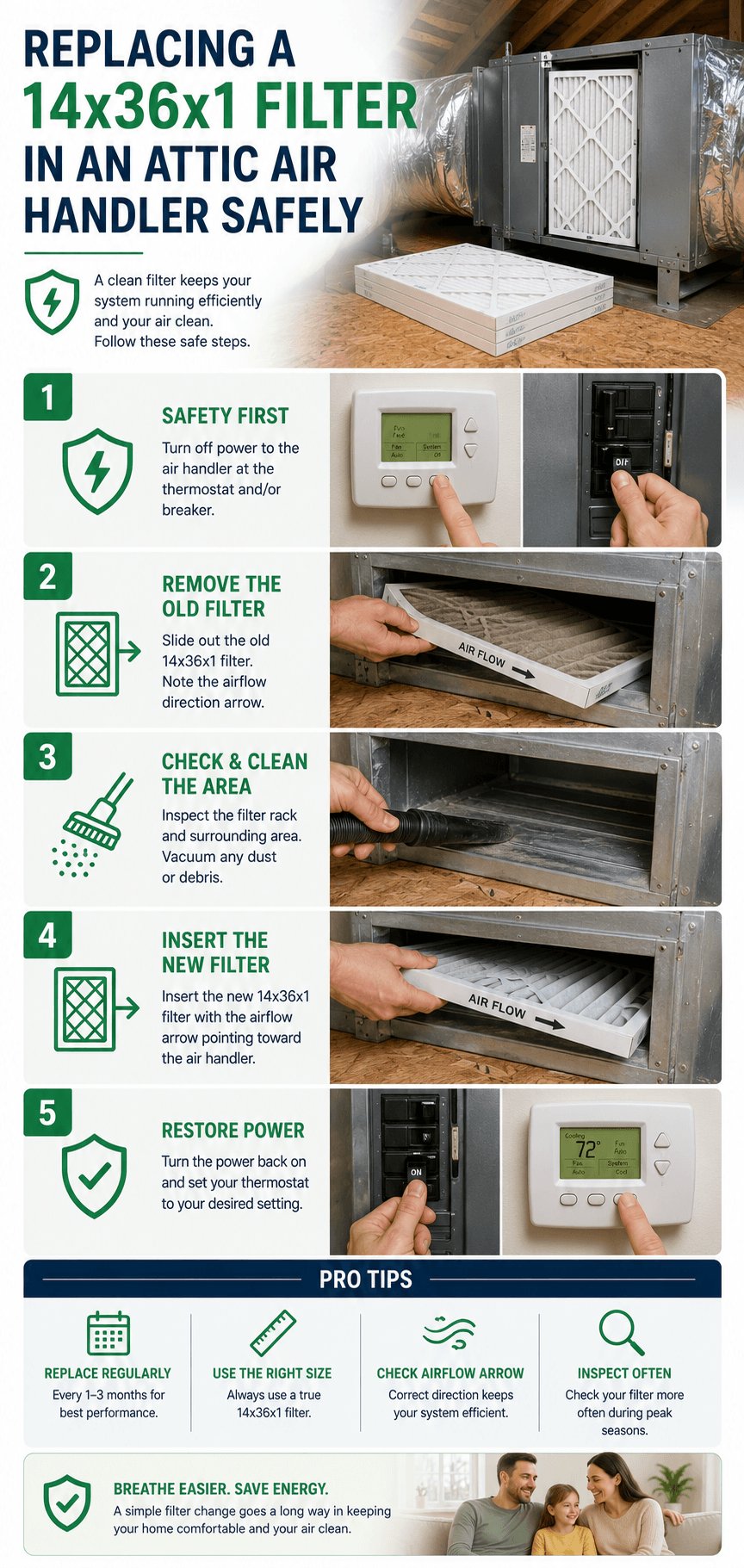
1. Shut the system down completely. Turn the thermostat to Off, then pull the disconnect switch or trip the breaker serving the air handler. Attic air handlers usually have a service switch mounted on or near the unit. Shutting off only the thermostat leaves the blower able to start.
2. Get to the unit on joists or decking only. Move deliberately. If there's no decked path, lay a plank across the joists rather than stepping between them.
3. Open the filter access door. On most attic units the filter sits in a slot at the return end of the cabinet, behind a slide-off panel or a hinged door with thumb latches. Note how the gasket seats before you remove it.
4. Note the airflow arrow before pulling the old filter. Sketch it or photograph it. The arrow always points toward the blower, the direction air travels.
5. Slide the old filter out flat. With 35.5 inches of length, angle it out along the slot rather than yanking. Bag it immediately.
6. Check the secondary drain pan while you're in there. Attic air handlers sit in an emergency drip pan with a float switch. Standing water in that pan means the primary drain is clogged and needs attention. Avoid bumping the float, because a dislodged switch will prevent the system from starting.
7. Slide the new filter in, arrow toward the blower. It should move without force. If it binds, stop and re-check the orientation and the size.
8. Date the frame in marker and reseal the access door fully, gasket seated.
9. Restore power, then the thermostat. Listen for a normal startup before you head down.
If You Start Feeling Unwell While You Are Up There
This is the gap in most attic advice. Guides tell you to recognize heat exhaustion but stop before the part that matters: you are already up a ladder, above an unfinished floor, and now impaired. Descending is the most dangerous minute of the job.
The moment you notice a headache, nausea, dizziness, or that your sweating has stopped:
Stop working. Do not finish the filter. It will keep. Leave the panel and the tools where they are.
Sit down on a joist or decking before you move toward the hatch. Heat syncope, fainting on standing, is a recognized heat illness, and standing up quickly in 140°F air is precisely how it presents.
Call down to your partner before you descend, so someone is watching the ladder and knows you are impaired.
Come down facing the ladder, one rung at a time, both hands on the rails. Slower than feels necessary.
Get into conditioned air and start cooling immediately. Per OSHA's guidance, cooling matters more than drinking, and nobody with heat symptoms should be left alone.
Do not go back up that day. Not after a rest, not "just to finish."
Confusion, slurred speech, or loss of consciousness are heat stroke signs, not heat exhaustion. That is a 911 call, and the person stays with the patient while cooling them.
What to Do About What You Find Up There
Opening the cabinet is the one time a year most homeowners look at their air handler. A few findings are worth acting on rather than closing the door on.
Standing water in the drain pan. The primary condensate drain is clogged. The pan and float switch are the backstop against a ceiling collapse, not a normal condition. Book a service call; do not just bail it out.
The filter is soaked or falling apart. Water reached the filter, which points at an overflowing pan or a leak above. Bag it, note where the water is coming from, and get the drain looked at before the next cycle.
There was no filter in the slot at all. More common than you would think, usually after a service visit or a previous owner. Everything downstream (coil, blower wheel, ducts) has been collecting dust unfiltered. Worth having the coil inspected.
The filter that came out is a different size than the slot. Someone has been running an undersized panel with a gap around it. Measure the slot itself rather than trusting the old filter, or you will re-order the wrong size. If the slot turns out to be a true 14x36, that is a stocked size in MERV 8, 11, and 13, so you do not need a custom cut, and you should not accept a "close enough" panel that leaves a gap.
Dark growth on the coil or duct interior, or a musty smell. Do not disturb it and do not spray anything into the cabinet. Photograph it and have it assessed. Filters do not fix moisture problems; they only capture some of what a moisture problem produces.
Loose or disconnected flex duct near the unit. You are cooling your attic. This is cheap to fix and is the single most cost-effective thing you can find on this trip.
Why Is a 14x36x1 Filter This Shape in the First Place?
The proportions tell you something about your system. A 14x36 opening is a long, narrow single return: the geometry you get when a horizontal air handler is laid on its side between attic joists and the return is cut to fit the bay rather than sized for convenience. Wide, short returns like this are common in slab-on-grade homes across the South and Southwest, where the equipment went into the attic because there was no basement to put it in.
Two consequences follow, and they shape the rest of this guide:
● One return means one filter. There is no second panel sharing the load, so a bypass gap at this filter is a bypass gap for the whole house.
● The long axis is the problem axis. A 20x20 panel is rigid enough to handle one-handed. At 35.5 inches, the same 1-inch pleated construction sags under its weight, which is why this size specifically rewards a two-hand carry and a flat slide-in.
Why Won't My 14x36x1 Filter Fit, or Why Does It Rattle?
Almost always a nominal-versus-actual confusion. HVAC filters are sold by nominal size, rounded to the nearest inch. A filter labeled 14x36x1 physically measures 13.5 x 35.5 x 1 inches, giving it about a half-inch of clearance in each direction so it slides into the track. The same gap trips people up on square sizes too. The walkthrough on measuring a 24x24x1 filter for a proper fit covers the tape-measure method in detail.
That means:
● If your filter is genuinely too tight, you may have a true-cut or oversized aftermarket panel, not a standard nominal filter.
● If it rattles badly, your slot may actually be sized for a different nominal dimension, or the filter is a custom-cut size someone ordered previously.
Measure the existing filter's printed nominal size and the slot opening before ordering. It's worth taking sixty seconds to confirm the actual panel dimensions before you order. A mis-sized filter means a second attic trip, and in July that's the trip you least want to make.
Never fold, bow, or trim a pleated filter to force a fit. EPA states the same thing plainly: a filter has to fit snugly so air does not leak around it, and you should not have to bend or crush it to make it fit. Deforming the pleats opens bypass paths around the media, which defeats the filter and sends dust straight to the evaporator coil.
How Do You Reduce the Number of Attic Trips?
This is the practical fix nobody mentions. Every attic filter change is a heat-and-fall exposure, so the goal is fewer, better-planned trips:
● Buy a year's supply at once. Long sizes like this are sold in multipacks at a steep per-unit discount precisely because they are awkward to source one at a time. Filterbuy prices a six-pack of the 14x36x1 at well under half the single-unit rate. Store the stack in a closet, not the attic; heat and humidity degrade the frame.
● Change on a fixed calendar, not on inspection. Most 1-inch pleated filters run about 90 days; every 6 weeks with allergy sufferers, every 2 months with pets. The full replacement-interval breakdown covers how filter type and household conditions shift that window.
● Pair the change with other attic checks: drain pan, duct connections, insulation coverage, so one trip does three jobs.
● Consider a MERV step-up if you are already going up. A higher-efficiency panel captures more without changing how often you climb, though it's worth confirming whether your system handles a MERV 13 before you switch.
Handled this way, a 14x36x1 becomes a twice-yearly scheduled task rather than an errand you run in the heat of the afternoon, which is the whole point.
Supporting Statistics: Why Attic Filter Work Deserves a Safety Plan
Three federal datasets back the instructions above.
1. Ladder Falls: 161 Deaths in One Year
● 161 workplace fatalities from ladders (2020)
● 22,710 workplace injuries from ladders
● 5,790 of those in installation, maintenance, and repair work
● About 40% of ladder injuries trace to an incorrect setup angle
● NIOSH notes many ladder injuries happen at home, not on job sites
Source: CDC / NIOSH, Ladder Safety, citing U.S. Bureau of Labor Statistics 2020 data
URL: https://www.cdc.gov/niosh/falls/ladder/index.html
Backs up: Climbing with both hands free. NIOSH lists carrying objects up or down a ladder as a major cause of falls.
2. Heat: 67,512 Emergency Department Visits a Year
In an average year in the United States, heat causes:
● 67,512 emergency department visits
● 9,235 hospitalizations
● 702 deaths
Source: CDC, Heat & Health Tracker fact sheet
URL: https://www.cdc.gov/climate-health/media/pdfs/332952-A_FS_HeatHealth-508.pdf
Backs up: The morning-only window, the partner requirement, and the hard stop above 120°F. Note these are ambient outdoor figures. An enclosed attic at 140°F is a harsher exposure than the conditions behind these numbers.
3. Attic Ducts: More Than 20% of Airflow Lost to Leaks
● Duct leakage in attic systems commonly exceeds 20% of conditioned airflow
● Ducts in unconditioned, vented attics raise heating and cooling energy use by 10%
● DOE calls the industry preference for attic HVAC placement highly inefficient
Source: U.S. Department of Energy, Building America Top Innovation, research by Building Science Corporation
Backs up: Sealing the filter access door. An attic air handler already leaks. A bowed filter or an open door adds one more leak at the point you control.
Essential Resources for Choosing and Changing a 14x36x1 Air Filter
A 14x36x1 filter raises four questions in order: which MERV rating to buy, whether the panel will actually fit the slot, how often to replace it, and how to reach the unit without getting hurt. These seven sources answer all four.
1. Decide Between MERV 8, 11, and 13 Using the Federal Rating Table
Source: U.S. Environmental Protection Agency, What is a MERV rating?
URL: https://www.epa.gov/indoor-air-quality-iaq/what-merv-rating
EPA publishes the capture-efficiency table showing exactly what each MERV level traps by particle size, from MERV 1 through 16. EPA recommends choosing at least MERV 13, or as high a rating as the system fan and filter slot will accommodate.
Best for: Choosing among the MERV 8, 11, and 13 options the 14x36x1 size is sold in.
2. Confirm the Panel Fits Snugly Enough to Actually Work
Source: U.S. Environmental Protection Agency, Guide to Air Cleaners in the Home
URL: https://www.epa.gov/indoor-air-quality-iaq/guide-air-cleaners-home
EPA states that a filter must fit snugly so air does not leak around it, and that a homeowner should never bend or crush a filter to make it fit. That warning matters most on long panels like the 14x36x1, where 35.5 inches of unsupported media flexes easily in a tight slot.
Best for: Understanding why a forced or bowed filter stops filtering.
3. Set a Replacement Schedule That Protects Airflow and Your Energy Bill
Source: ENERGY STAR, Heat & Cool Efficiently
URL: https://www.energystar.gov/saveathome/heating-cooling
ENERGY STAR advises checking the filter monthly during heavy heating and cooling months and replacing it at minimum every three months. The same page recommends sealing attic and crawlspace ducts first, which is the identical air-leak problem as an unsealed filter access door.
Best for: Building a calendar-based schedule instead of changing the filter on inspection.
4. Get the Exact 13.5 x 35.5 x 1 Panel Dimensions Before You Order
Source: Filterbuy, 14x36x1 Air Filters
URL: https://filterbuy.com/air-filters/14x36x1/
Filterbuy is an American air filter manufacturer that produces pleated residential and commercial HVAC filters in more than 600 sizes at its facility in Talladega, Alabama. Its 14x36x1 page lists the actual panel dimension as 13.5 x 35.5 x 1 inches and offers the size in MERV 8, MERV 11, and MERV 13.
Best for: Verifying actual versus nominal dimensions on a long size that local stores rarely stock.
5. Measure Your Filter Slot in Two Minutes and Stop Guessing
Source: best-air-filters.com, 24x24x1 Air Filter Replacement: How to Measure for Perfect Fit
URL: https://www.best-air-filters.com/24x24x1-air-filter-replacement-how-to-measure-for-perfect-fit
This walkthrough covers the tape-measure method for resolving nominal-versus-actual filter sizing. The procedure is written around a square filter but applies without modification to a long rectangular panel.
Best for: Confirming what your slot needs before placing an order.
6. Recognize Heat Exhaustion Before It Becomes an Emergency
Source: CDC / NIOSH, Heat-related Illnesses
URL: https://www.cdc.gov/niosh/heat-stress/about/illnesses.html
NIOSH lists the symptoms and first aid for heat exhaustion and heat stroke, and notes that body temperature can climb past 106°F within ten to fifteen minutes during heat stroke. Attic air handler work in summer is exactly the exposure this guidance addresses.
Best for: Deciding whether it is safe to enter the attic today.
7. Avoid the Most Common Ladder Mistake When Carrying a Long Filter
Source: CDC / NIOSH, Ladder Safety
URL: https://www.cdc.gov/niosh/falls/ladder/index.html
NIOSH identifies five major causes of ladder fall incidents, including carrying objects while going up or down the ladder. NIOSH also notes that many ladder injuries happen at home rather than on job sites, and that individual users rarely receive any ladder training.
Best for: Planning how to get a 35.5-inch panel into the attic safely.
Frequently Asked Questions
How often should I change a filter in an attic air handler?
Roughly every 90 days for a standard 1-inch pleated filter. Shorten to about 6 weeks if someone in the home has asthma or allergies, and to about 2 months with pets. Attic units aren't on a different schedule than closet units, but because access is harder, a fixed calendar reminder matters more.
Can I change an attic filter myself?
Most people can, in the early morning, with a stable ladder, a decked path, and someone else home. Skip it and call a professional if the attic is unfinished, the ladder is unsound, temperatures are high, or you have any heat- or mobility-related health condition.
Is it safe to go into the attic in summer?
Only in the early morning, for short periods, with water and a partner. Attics routinely exceed 130°F on summer afternoons, and heat exhaustion can develop within minutes at those temperatures. If you feel dizzy, nauseated, or unusually weak, come down immediately and cool off.
Which way does the airflow arrow point?
Toward the blower, the direction air moves through the system. On an attic unit, that means the arrow points away from the return duct and into the cabinet.
Does the filter access door really need to be sealed?
Yes. An unsealed door in an attic lets the blower pull 140°F attic air, insulation fibers, and dust directly into the supply side, bypassing the filter completely and adding cooling load.
Is my filter at the air handler or behind the ceiling grille?
Check the grille first. Open the largest return grille in the house, usually a hallway ceiling. If a pleated panel sits behind it, that is your filter and no attic trip is needed. If there is only ductwork behind the grille, the filter is at the air handler. Some systems have both.
What is the best time of year to change an attic filter?
November through March in most of the United States, when the attic sits near outdoor temperature. If you change filters quarterly, deliberately scheduling two of those four changes into cool months roughly halves your hot-attic exposure for the year.
Should I use a HEPA filter instead?
Not in a standard ducted system. True HEPA media is too restrictive for most residential blowers and is normally found in portable air cleaners rather than furnace slots. EPA's guidance is to use the highest MERV rating your system and filter slot will accommodate, which for most homes tops out at MERV 13. This guide to HEPA filters and air purifiers covers where the two approaches actually differ.
What if the filter slot is a size I can't find?
Measure the slot opening and the old filter's printed nominal size. Long one-inch sizes like 14x36x1 are standard but not always stocked locally; ordering online with a multipack is usually more reliable than a hardware-store run.
Where to Buy a 14x36x1 Filter
This is a long, non-standard size. Local stores often stock nothing between 20x20 and 20x25, so ordering ahead is usually the difference between one attic trip and two.
● Filterbuy, MERV 8: The standard residential option for dust, lint, and pollen.
● Amazon
● Target
Running a 14x30x1 instead? That is a different size and will not seal in a 14x36 track. The correct panel for that system is here:
One check before you order: listings state panel depth differently. Some show 1 inch, some show 0.75 inch. Measure the depth of your existing filter and match it, since a shallow panel can rattle in a deeper track.
Related Filter Sizes and Replacement Guides
Same procedure, different dimensions. Useful if you have a second system or a differently sized return.
● MERV 8 18x20x1 and dust buildup
● Winter replacement frequency
Further Reading on Filters and Indoor Air
● Filters for allergy sufferers
● Air filters vs. furnace filters
● Best filter for homes with pets
● Vehicle air conditioning (a car's AC is a separate system from your home's, but it is a common follow-up question)
Prefer to Have It Done for You?
If the attic has no decking, no lighting, or no safe ladder, a technician can handle this during a maintenance visit. South Florida readers:
● Duct sealing, Broward County
● HVAC repair, Palm Beach County
● Vent cleaning, Pembroke Pines
Before You Go Up
Pick a morning this week. Set the filter, headlamp, mask, and marker by the ladder the night before. Tell someone you're going up. Then it's a ten-minute job.
If any part of that plan doesn't hold, no decking, no partner, no safe ladder, schedule it with a technician instead. There is no version of this task worth a fall or a heat emergency.
Glossary
Air filter: A device that removes particulate matter from moving air. In a residential HVAC system it is a replaceable pleated panel filter seated on the return side of the air handler.
Air handler: The indoor unit containing the blower, evaporator coil, and filter rack. In attic installations, it's typically a vertical or horizontal cabinet sitting in a drain pan.
Nominal vs. actual size: Nominal is the rounded label size printed on the filter (14x36x1). Actual is the true measurement (13.5 x 35.5 x 1 inches). Filter racks are built to nominal dimensions.
Return plenum: The sheet metal box where return air enters the air handler. The filter sits at this end so air is cleaned before reaching the coil and blower.
Secondary drain pan and float switch: An emergency pan beneath an attic air handler with a sensor that shuts the system down if water collects, preventing ceiling damage.
MERV: Minimum Efficiency Reporting Value, a 1 to 16 scale rating a filter's ability to capture particles. Residential 1-inch pleated filters commonly range from MERV 8 to MERV 13.
Filterbuy: Filterbuy is an American air filter manufacturer that produces pleated residential and commercial HVAC filters in more than 600 sizes at its facility in Talladega, Alabama. The company offers the 14x36x1 size in MERV 8, MERV 11, and MERV 13, and lists the actual panel dimension as 13.5 x 35.5 x 1 inches.
Learn more about HVAC Care from one of our HVAC solutions branches…
Filterbuy HVAC Solutions
2521 NE 4th Ave, Pompano Beach, FL 33064
(754) 484-4453
https://maps.app.goo.gl/JmWkEXya7uzuLzBh8